The new Prime Minister has faced up to MPs for the first time in the Commons, and the Reform Party conference has quickly descended into chaos. But despite all of this, the Party dominating the headlines this week has been the Conservatives. Kemi's Shadow Cabinet reshuffle, promoting to the top some of the best and the brightest the Conservative Party has to offer, has gone down well. Her appointment of Andrew Griffith is particularly interesting, and a reminder of a serious flaw in the government that Andy Burnham would do well to notice.
Griffith spent 26 years in the private sector before he ever stood for Parliament: qualifying as a chartered accountant with Coopers & Lybrand, moving into investment banking at Rothschild, then two decades at Sky, first as CFO and later as Chief Operating Officer. Whatever you think of his politics, it's a serious track record - someone who has had to administer payroll, run a P&L, and answer to shareholders.
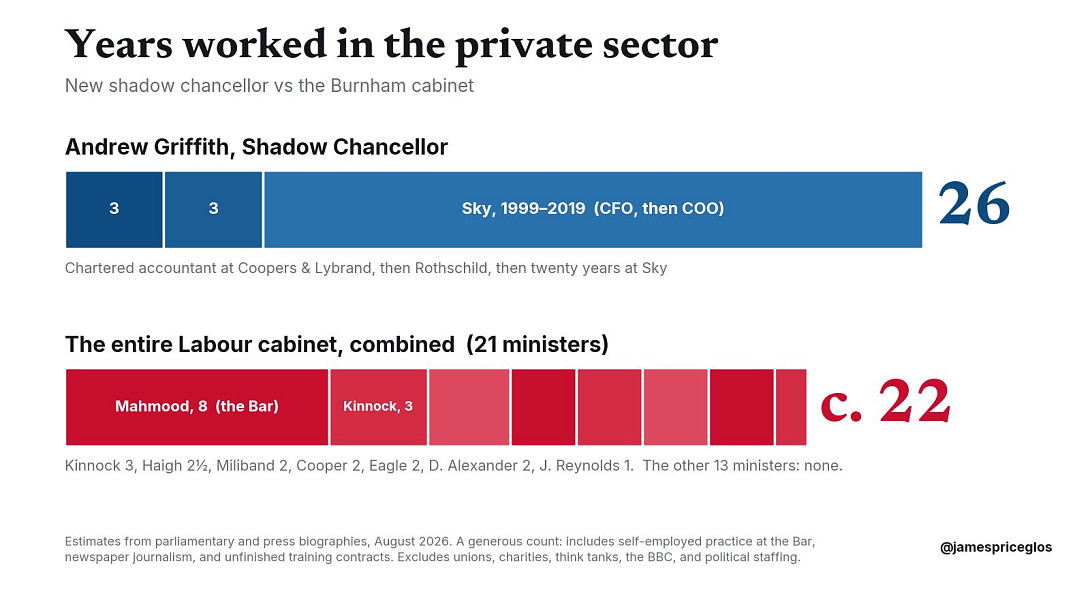
Compare that with the Labour cabinet as it currently stands. Across 21 ministers, generous estimates put the combined private sector experience at somewhere around 22 years - fewer, in total, than one man has accumulated on his own in the Shadow Cabinet. Shabana Mahmood accounts for a third of that figure through her years at the Bar. Kinnock, Haigh, Miliband, Cooper, Eagle, Alexander and Reynolds make up most of the rest, contributing between one and three years apiece. Thirteen of the 21 have no private sector experience at all.
This isn't necessarily a comment on individual ability, but speak to any business leader and they'll tell you that the lack of private sector experience concerns them, and that it is clearly demonstrated in government policy. They'll list Labour's Employment Rights Act, the increases in employers' NIC and changes to business rates relief as examples of measures that were clearly introduced without much concern for the businesses they'd impact. But business owners feel that this is a government with so little first-hand experience of running a business, it cannot be expected to understand what running one really involves: the cash flow pressures, the hiring decisions, the risk.
It's worth saying that a cabinet like Burnham's, so heavily weighted toward politics-as-a-career, law and the public sector, and so very light on private sector experience, will always struggle to convince businesses that it grasps how real growth is created. And it’s not just the Labour government’s policies that are damaging business confidence – it’s their rhetoric.
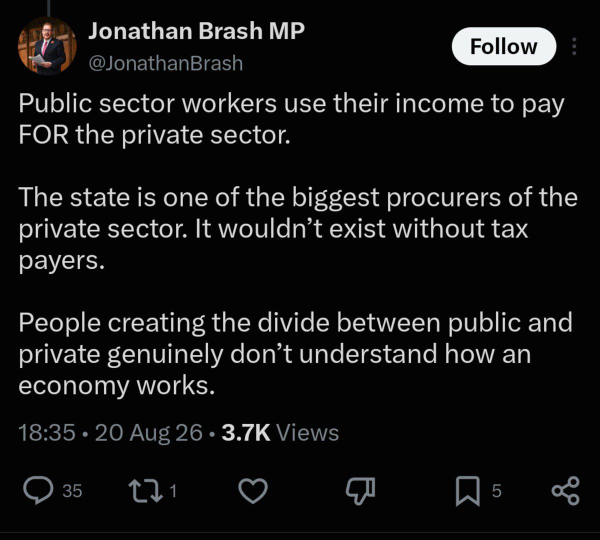
The Labour MP for Hartlepool, Jonathan Brash, recently argued on X/Twitter that it is public sector workers who "pay FOR the private sector," and that the private sector "wouldn't exist without" the state. There is not a clearer example of how very backwards some in the Labour Party view the relationship between government and private enterprise. When a sitting Labour MP can get the basic direction of that relationship the wrong way round, it's hard to be surprised by the policies being put forward by the present government.
Unfortunately, the lack of business experience in the cabinet isn’t easily fixed. Look beyond the cabinet at the wider Parliamentary Labour Party and the background of MPs is much the same. Incredibly, 90% of the new Labour MPs at the last election came from a trade union, charity or public-sector background. There are so very few who have started a company, met a payroll, or taken on the responsibility of running a business. Evidently, the Labour Party’s candidate recruitment and selection processes are themselves flawed and are failing to bring business-minded people in.
Business is the foundation of Britain's prosperity. Indeed Napoleon, who knew us well by the end of his life, called us a "nation of shopkeepers".
Griffith's appointment is a reminder that experience of running a business is a credential worth having in government. If Burnham is serious about getting our country's economy back-on-track, he should learn a lesson from Kemi Badenoch and begin to surround himself with people who have experience outside the public sector. If those sorts of people don’t exist in the Labour Party, then serious work must be done to try to attract them into politics. It is paramount for the future of our country.
Kiran Fothergill is Director of Pickerings Lifts and Chair of the Jobs Foundation North East.